The Academy Also Turns Up at the 1968 Nastri d’argento
A 14-minute read
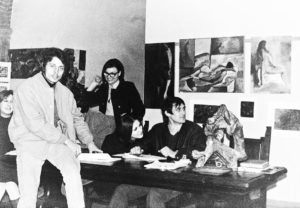 “The moment one must watch very closely is the one when, at the side of the camera, the little red light comes on; that is the moment, Pio Baldelli[1] used to say, not a minute before or after.”
The twenty or thirty students of the Bernardino di Betto Art Institute and of the adjoining Pietro Vannucci Academy of Fine Arts stayed silent; they asked no questions but looked at Baldelli quizzically.
“This awards ceremony for film actors and directors, broadcast by Rai television, is one of the first that will go out live, or rather, after a short delay. That leaves very little time to cut and keep unwanted scenes off the air. Ours will be an act of protest and counter-information which, if all goes well, will be seen, if only for a few minutes, throughout Italy, especially since these broadcasts generally open with a panning shot of the audience in the hall.”
“In any case there will be no problems; I am the one who will give the signal to set our protest in motion,” broke in, in a peremptory tone, the student chairing the meeting, “and besides, we must be convinced of the worth of what we are doing. We must be united, move all together, and let nothing whatsoever of our intentions leak out.”
The meeting was being held in a lecture room of the Academy of Fine Arts that had long been under occupation.[2]
After that, everyone set about preparing the necessary materials: leaflets to set out the students’ demands, and large banners bearing slogans to be lowered into the stalls from the second gallery of the Turreno cinema, for that was where the action would be concentrated.
Meanwhile a discussion had flared up about how to get the materials being prepared into the theatre, thus outwitting the checks the police would surely put in place.
Getting into the event was no problem: we had a thick bundle of invitations obtained for us by Pio.
In the end the solution arrived: the women. Yes, the women would carry all the material into the theatre under their skirts, the banners wound around their waists and the leaflets divided into small bundles. It struck us as a piece of urban-guerrilla strategy to be proud of.
In the preceding days a press conference had been called in the Sala della Vaccara of the town hall to restate and set out in greater detail the students’ demands and the reason for the occupation, which by then had been going on for about two weeks. In the same room a number of the students’ works were on display, put up for sale to fund the occupation.
The struggle of the students of the Academy of Fine Arts, seconded by those of the Bernardino di Betto Institute (both housed, in the early years of the last century, in the former convent reached through a small portico set between the church of San Francesco al Prato and the graceful oratory of San Bernardino), had begun with the occupation of 1964.
It was in April that the turning point came: in step with every academy in Italy, the Perugia students went on strike and occupied the school to safeguard the assemblies that proclaimed the importance of their demands (first among them the transformation of the Academy into a university faculty[3], together with the call for a radical reform of studies). The shifts alternated accordingly: some kept up the occupation while others spread word of the struggle, collecting funds and provisions and organising events.
On the fifth day of the occupation, the intervention of the police and the carabinieri, called in by the headmaster of the Bernardino di Betto Art Institute, forced the students to barricade themselves on the second floor of the building, thus cut off from the outside entrance.[4]
After ten days the occupation came to an end, but it had won the solidarity of all the student and university organisations and of the teaching staff, as well as the support of several Umbrian members of parliament, for their demands.
The year is 1946 when the national union of film journalists (SNGCI) promotes the creation of a prize devoted entirely to Italian cinema, given the name “Nastri d’argento”.
The first ceremony awarding the Nastri d’argento takes place on 29 July of that same year.[5]
After that first occasion the event, created to showcase film production, would be held every year without interruption. No small achievement: together with the Oscars, it is one of the most important and long-lived events devoted to cinema.
The Nastri d’argento are usually held in Rome or in the striking setting of the Greek Theatre of Taormina, with a few exceptions. In 1967, for instance, it was held in Florence, after the flood of 4 November 1966, as a gesture of solidarity with the city and its “mud angels”.
Mud angels: so were called the thousands of young people, mostly students, who rushed to Florence from all over Italy and even from abroad to help the population and to help save its immense artistic and cultural treasure, a true heritage of humankind.
Tremendous solidarity came from the city of Perugia and from all of Umbria, with collections of funds, medicines, clothing, provisions and drinking water.
It is thanks to the insight of the director of the Perugia State Archive, Professor Roberto Abbondanza, and to the financial means of the Lions Club, that in the very first days after the flood steps were taken to try to save thousands of manuscripts and documents from the Florence State Archive and the volumes of the National Library of Florence. The material was transported (dozens upon dozens of lorries would be needed) from the Florentine archive to the Perugia premises of the Tobacco Monopoly, to be treated with special procedures and passed through the drying ovens so that books and documents might dry properly, while the volumes of the National Library were sent to the drying ovens of Città di Castello.
This first phase too, decisive in saving the paper material, was made possible by the great many volunteers, above all students from Perugia, who worked tirelessly under the expert guidance of Professor Abbondanza.[6]The Province of Perugia, with the collaboration of the Municipality of Perugia and of other town councils in the province, offered to take full charge of the Santa Croce district in Florence, to enable it to return completely to normal life.
In October 1951 the Perugia Cine Club organised the “Week of Film Culture”. The aim of the week was to read cinema not merely as a moment of spectacle and diversion but also as a work of art and of culture.[7]
The expressions of support for the “Week” from Cine Clubs across Italy, and from directors, film critics, actors, actresses and artists, are beyond counting. The programme features screenings of films and documentaries, lessons and lectures.
Some years later the National Union of Film Journalists (SNGC), which until then had overseen every edition of the Nastri d’argento, would launch the “Nastri d’argento Festival”. The event, presenting, duly restored, the greatest successes of the previous ten years, takes place (between June and July 1958) simultaneously in Rome, Milan, Turin, Bologna and Perugia. In our city the Festival is held entirely at the Turreno theatre-cinema.[8]
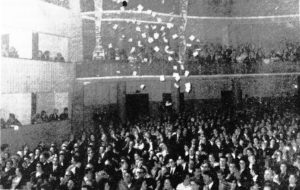 Let us return to 1968. It is Sunday 24 March, and the city is astir, with a touch of excitement too. This evening the Nastri d’argento, the coveted recognition for our cinema, will be presented at the Teatro Turreno. The choice of Perugia looks like a tribute to the city and to its love of cinema.
Slowly the guests flowed into the theatre for the awards of this twenty-third edition, with prizes to be presented to actors and directors of Italian cinema. An Oscars made in Italy, in short. The students began to enter in small groups of two or three (and in each group the female presence was conspicuous!), mingling with the other guests. Getting into the second gallery was not difficult: as agreed, the students arranged themselves in a semicircle so as to occupy, in effect, the seats that looked directly down onto the stalls.
The theatre was filling up: in the front rows of the stalls sat directors, actors, producers and screenwriters, along with the authorities, such as the provincial Prefect and the Mayor. The rest of the stalls was taken up by correspondents from every national and local paper and by the guests. In the first and second galleries, meanwhile, sat all those holding an invitation.
The Teatro Turreno was by now packed to bursting, and the air was that of a gala evening. A cheerful, almost joyful atmosphere filled the hall.
As they waited for the ceremony to begin, with the presentation of the Nastri d’argento, a certain nervousness was also mounting among the students, owing not only to the action awaiting them but also to the fact that, in the meantime, several policemen, some of them in uniform, had appeared in the second gallery, perhaps made suspicious by this large presence of young people.
And so: it begins. At the microphone is Lello Bersani, the veteran radio and television host of events and shows, ready to start, as are the television technicians.
Among the audience, an elegantly dressed gentleman in formal attire and a bow tie seems particularly pleased to be there, among all those fine people. He is the chief superintendent of the political branch of the Perugia police headquarters, and his composure rests too on a massive security detail whose task, outside the cinema, is to screen the invitation-holding public.
The moment silence falls, the host takes the floor, greets the audience and begins to extol the evening’s entertainment, but gets no further… The students, young men and women of the Art Institute and of the Academy of Fine Arts, who have managed to get in in large numbers and to slip past the police checks, lower from the second gallery banners that graze the stalls, and a rain of leaflets interrupts Lello Bersani, as if to explain the reasons for the student protest.
Bersani, caught on the wrong foot, cannot stem the improvised speech of the student who, from the second gallery, leaning out a little over the balustrade, manages to rise above his voice despite having no microphone of his own. Taken by surprise, two uniformed police officers on duty in that gallery rush towards the student and rashly seize him by the arms, but the young man reacts at once: “This is a peaceful student demonstration, police out of the Turreno!!”
To the audience in the stalls, who were in part already following the scene, it must have looked like a dangerous situation, with the student leaning out over the balustrade and the two policemen holding him by the arms. To restrain him? But there was no need for that… So why, then? To drag him away by force and thus cut the protest short?
Then came the coup de théâtre: Gian Maria Volonté rose to his feet and, turning towards the second gallery, began to applaud, shouting: “long live the students!!”.
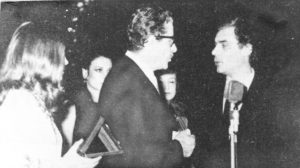 As if by a domino effect, applause broke out (more or less heartfelt) from the audience, who had all risen to their feet, perhaps unconsciously following Gian Maria Volonté’s spontaneous gesture. The officers therefore quickly released the student’s arms.
The gentleman with the bow tie had meanwhile turned pale, realising at once that a transfer awaited him, perhaps to Sardinia, where kidnappings were rife in those days.
The upshot: the episode had national resonance and appeared (though cut) for a few seconds on television. Beyond solidarity, the students collected funds to finance the student movement; they did so later at the Città della Domenica, where the artists had gone to attend the reception held in their honour by the city authorities. The donors? From Gabriele Ferzetti to Gillo Pontecorvo, from Elio Petri to Ugo Pirro. The most generous? Gian Maria Volonté.
Afterwards a group of filmmakers issued the following statement: “The artists who took part in the presentation of the Nastri d’argento, during which the students demonstrated over the problems arising from the present situation of the Academies of Fine Arts, the Universities and the school system in general, feel that they share the approach the students are pursuing in their struggle, centred on the issues of the right to education, the end of academic authoritarianism and a reform of the whole of artistic instruction. They also express solidarity with all the students who in Italy pay, with imprisonment and judicial persecution, for their commitment to building a new school in a new society.”[9]
Incidentally, the most coveted of the Nastri d’argento[10], those for best direction and best leading actor, went respectively to the director Elio Petri and the actor Gian Maria Volonté, for a film based on a novel by Sciascia.
The title? We Still Kill the Old Way.
Notes
Notes
[1] Pio Baldelli (Perugia, 23 January 1923 – Florence, 20 June 2005), a Perugian intellectual and a pupil of Aldo Capitini, taught at several upper-secondary schools in Perugia and later held university posts in Cagliari and then Florence. He produced numerous essays and books as a film critic and historian and as a scholar of mass communication.
[2] The Academy and the Art Institute were among the most active and determined institutions in the student struggles. The students enrolled there took part en masse in the great demonstration of 9 March 1968, called by the student movement, which brought many thousands upon thousands of students into the square.
[3] La Nazione, 22 April 1964 (They want a degree at the art academy, Perugia news).
[4] Il Messaggero, 25 April 1964 (Police and carabinieri step in to reopen the Art Institute’s premises, Perugia news).
[5] In the immediate post-war years, when the national cinema was defining itself through Neorealism. The first film to be awarded was Rome, Open City (1946) by Roberto Rossellini. This first event took place in Rome, at the Hotel de Russie.
[6] Il Messaggero, 15 November 1966 (Perugia students at work to save precious documents, Perugia news).
[7] Il Messaggero, 2 October 1951 (“Cinema and Culture” by Luigi Chiarini, the opening topic of the “Week” in the Umbria news). Other occasions for reflection on cinema were those of Guido Aristarco, Cinematographic Literature; Professor Carlo Ludovico Ragghianti, Cinema and the Figurative Arts; Alberto Lattuada, Fear of Cinema; Carlo Lizzani, The Documentary: a Prelude to Realism.
[8] Here is the programme of the Festival’s screenings. 30 June: “Rome, Open City” by Roberto Rossellini; 1 July: “The Sun Still Rises” by Aldo Vergano; 2 July: “Paisan” by R. Rossellini. 3 July: “Tragic Hunt” by Giuseppe De Santis; 4 July: “Bicycle Thieves” by Vittorio De Sica; 5 July: “The Earth Trembles” by Luchino Visconti; 6 July: “Story of a Love Affair” by M. Antonioni; 7 July: “Variety Lights” by A. Lattuada and F. Fellini; 8 July: “Eager to Live” by Claudio Gora; 9 July: “Miracle in Milan” by Vittorio De Sica.
[9] L’Unità, 26 March 1968 (Directors and actors in solidarity with the students’ struggle, p. 13, Entertainment). The motion was signed by the directors Gillo Pontecorvo and Elio Petri; by the actors Gian Maria Volonté, Gabriele Ferzetti, Annabella Incontrera, Stefania Careddu and Nicoletta Machiavelli; by the writer and screenwriter Ugo Pirro; by the documentary-maker Ansano Giannarelli and the documentary producer Marina Piperno; and by the producer Alfredo Bini.
[10] Corriere della Sera, 23 March 1968 (Here are the Nastri d’argento, p. 13, Entertainment).
Aldo Peverini has written articles and essays on advertising and on communication, both commercial and political, including a survey of the state of advertising in Umbria, subsequently published. He has worked for around thirty years in the field of communication and advertising, commercial as well as institutional and political, founding communication agencies or working as a consultant. He recently edited the volume Quando la politica era passione (“When Politics Was Passion”), a chronicle of 1970s Umbria, recounted, annotated and accompanied by a wealth of photographs. He is the author of the text and screenplay of Storia di Perugia a fumetti (“The History of Perugia in Comics”), first published in 1980 and now in its third edition, being printed in a new format. Storia di Perugia received joint first prize in the young-readers’ section at the first edition of the Regional Literary Prize promoted by Umbria Libri in 2018.