Eating and Drinking. Goethe and Other Travellers of the Grand Tour
A 38-minute read
The mild air and inexpensive food make life easy
(J.W. Goethe, Italian Journey)
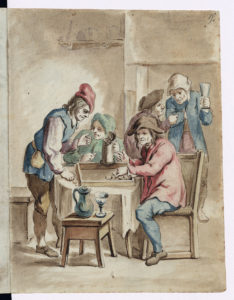 Those who came to Italy in the age of the Grand Tour certainly did not do so for gastronomic purposes, for that we should have to wait a good deal longer, yet this did not prevent many of them, en passant, amid their admiration for an ancient statue, venerable ruins and a Renaissance painting, for a sublime landscape and their taking part in one of the many festivals that marked life in the Bel Paese, from noting in their diaries various aspects of material culture, and hence of the differing habits of the table. Reading these memoirs allows us to learn what was eaten in the places the travellers visited and, in some cases, to learn too of the eating customs and usages of the different social classes. In many texts we find a description of the various kinds of meal: from that of the aristocracy, to which important travellers were invited, in which case these were codified meals conducted according to precise rituals, both in the quality of the dishes and in the manner of consuming them, to the everyday meals of the well-to-do, and finally those eaten in the taverns and posting stations, very like those consumed by the common people. Food is also an element of comparison between one’s own model of life and that of others. Eating marks differences of taste, sets up scales of value, underscores a superiority real or presumed, becomes a term of comparison. This is what we find in many travellers’ writings.
In 1740 the president of the Parlement of Burgundy, Charles de Brosses, was in Rome for his Grand Tour, and on 13 December he was invited to the traditional dinner given by the ambassador of France, attended by aristocrats and cardinals, of which he leaves us this description:
This dinner is among the most curious things to be seen here. There were a hundred and fifty of us, seated along the two sides of a single horseshoe-shaped table, ending in a shell shape at either extremity. […] Four butlers directed the service with their footmen, distinguished into squads by coloured ribbons: each had its own entrance through a different door of the hall. Before sitting down, I counted on the table forty-nine trays or enormous dishes laden with citrus fruit. The Duc de Saint-Aignan told me after supper that these alone had cost him 800 livres; they formed the vanguard of the fruit still to come, which filled out the ranks at the end of the dinner with two rows of crystal trays. […] This banquet is a veritable pillaging on the part of masters and servants alike, carried out with scandalous effrontery. No sooner had the soup plates been carried off than a throng of unknown lackeys came with dishes to request the various courses for their masters; one of them in particular had fastened himself upon me, as the most guileless of the company. I made him a present of a turkey, a pullet, a slice of sturgeon, a partridge, a piece of roe deer, some tongue, some ham; and back he came, again and again. […] Indeed, I noticed that the more discreet among them stuffed whatever came to hand into their pockets, wrapping a pullet with truffles in a napkin for cleanliness’ sake, the linen too being of good quality. […] I was even assured, as a thing absolutely certain, that this emulation in pillage extended as far as the masters, and that when an Italian nobleman found a dish to his liking he would dispatch it to his house by means of his lackey. […] The finest scene was at the moment of the fruit. While it was being served, every foot could be heard stamping with impatience. No sooner was it set down than arms flew from all sides over our shoulders, to pillage now without any restraint; the servants of the house, and even the pages, like Aesop’s dog carrying its master’s dinner, flung themselves into the feast as fast as they possibly could. Not one of the guests tasted a single fruit; we had to rise and leave the meal. That day candied citron perished in untold numbers, but on the field of battle no corpses remained[i].
Beyond the grotesque aspects of the scene that Brosses’s felicitous pen describes for us, it is interesting to observe the dishes that had been set upon the table: turkey, partridge, roe deer, salmon, ham, candied fruit and more, costly, sought-after foods, an expression of the food culture of the privileged classes. The turkey, incidentally, the only animal to come from the New World, and one that readily, being a farmyard bird and thus assimilable to familiar creatures, had entered the aristocracy’s diet as early as the first decades of the sixteenth century under the name of gallo d’India, accompanying and then supplanting the peacock, was by the eighteenth century no longer a food reserved to the aristocracy, its rearing having spread throughout the country; and Goethe, as we shall see, numbers it among the meats sold at the market in Naples.
Against these banquets stands the food that travellers found in the taverns along the roads and in the towns. For the most part it was poor fare of scant quality, served in surroundings much neglected from the point of view of hygiene.
At the close of his journey the French Huguenot François Maximilien Misson, whose work enjoyed great success and was at the same time placed on the Index in the Papal States, wrote a sort of compendium of what his journey through Italy in 1688 had been, and on the matter of food he noted:
Nothing is more wretched than a meal in the inns of the small towns, and particularly along certain roads. They begin the meal with a dish they call Antipasto, which is a dish of gizzards, or of feet and wings boiled with salt and pepper and mixed with a little white of egg. Two or three dishes of various stews follow one upon another, but all in small measure. Going from Rome to Naples one may sometimes have buffalo or crow: always supposing one is lucky. Buffalo is a dark meat, foul-smelling and tough, which only the Jews of Rome, or other poor folk like them, are accustomed to eat[ii].
Hardly enticing. As for wine, Misson writes that there is a great deal of it, but the good ones are rare; butter is almost non-existent and of poor quality (we shall return to this later), while the fruit is excellent, in particular the cherries of Genoa and the winter melons of Naples. Another French traveller, Pierre-Jean Grosley, in Italy in 1758, recounts his experience at an inn in Capua thus:
The table setting consisted of a dirty cloth spread over three boards resting on two benches. Two old Bicchieri, or earthenware vessels, were filled with a bad wine, and we were told that glass tumblers were not in use in this country; we drank one after another from the bicchieri. A leg of an old billy-goat, a fricassee cooked in lamp-oil and a salad were part of the feast, with bread as bad as the wine. We could not bring ourselves to touch this fine fare, and our supper came down to a little fruit that we devoured without bread.
The English poet Anna Miller, travelling through Italy together with her husband, was at Narni in 1771 and describes her experience of the food thus:
At Rome I had provided myself, as regards our concerns about food, with a piece of cold boiled beef, dressed in the English manner, and a few dozen lemons, for we generally drink nothing but lemonade during our journey, on account of the heat of the climate, and, the robust wines of this region being rather heady, we found our provision quite necessary, since our inn offered us nothing but eggs not altogether rotten; no butter, plenty of stale and coarse bread, and no other kind of meat but goat, which I could not eat unless at death’s door; the rancid smell fills every room in the house, and I have a dreadful aversion to the smell of these animals whether alive or dead: our host, it is true, offered us some old half-dead fowls that were insistently squawking and clamouring for food at the door, and that he would have killed on the spot had he been allowed, but we preferred our cold beef to the fruits of such slaughter, and on it we dined very well[iii].
The Grand Tour travellers, coming from the countries of northern Europe, had butter as their principal fat; once the Apennines were crossed it was practically nowhere to be found, and of this they complain, not caring for olive oil in the same way. But it was not merely a question of taste: it turned on the fact that more often than not the oil was of very poor quality, rancid and black in colour. President de Brosses, on the subject of oil, writes: “all those of Calabria, of the Kingdom of Naples and of Italy entire, and even that of Lucca, the most prized of all, are disgusting, fit for making ointments, a veritable game-preserve for apothecaries”[iv]. And the French Dominican friar Jean-Baptiste Labat complains, churchman though he is, that during the seasons of abstinence, at least in Italy, one may not eat butter: “This custom cost me dear in the first Lent I spent in Italy: since I could not accustom myself to oil, and everything served up was in oil, I often made very poor meals”[v]; the English musicologist Charles Burney too has his objections: “all the food is dressed with rancid oil, which I detest to such a degree that the mere thought of it turns my stomach”[vi]; while the Swiss count Carl Ulysses von Salis-Marschlins, on his journey through the Kingdom of Naples in 1789, observes in Apulia that “no more butter is made than is needed for the family’s own use, this food being little taken up throughout the Kingdom, where oil is consumed and relished in preference”[vii]. The English painter Thomas Jones, at Naples in 1780, observes that butter is still an article of luxury and that they do not know how to work the churn, and he begs the dairyman to let him have some butter, to which the man replies that it “was not good for Christians but was given to pigs”[viii].
To read her diary, cast in epistolary form, we find that, besides the passage we have quoted, Miller is more than once forced to go to bed without eating: as near Fiorenzuola, in the neighbourhood of Piacenza, where the host offered up a pig’s head complete with eyes, eyebrows and nose, and other “delicacies” that they declined; near Radicofani supper consisted of the putrid, ill-identified flesh of some fowl, with rancid oil for its sauce, wretched bread, and wine and water that tasted of mud. At Bologna, by contrast, whose various gastronomic specialities she pauses to describe, and at Naples she fares well. She was not the only one to complain of the food eaten in Italy. The Scottish physician and writer Tobias Smollett, for instance, endowed with a biting and venomous critical wit, in Italy in 1764, complains without cease of the cooking and of the extortionate demands of the innkeepers: “when we did find provisions, we were almost poisoned by the way in which they had been cooked”[ix], he writes near Civita Castellana, and near Arezzo “the victuals dressed in such a fashion that not even a Hottentot could have looked at them without disgust”[x]; only at Rome does he declare himself content: “provisions at Rome are not costly and are good; the veal called mongana, however, which is the most delicate veal I have ever tasted, is very dear”[xi]. It is no accident that even the hypercritical Smollett should relish mongana veal. This is in fact the meat of a very young calf, female, extremely tender and unlike that eaten for the most part in France and England, which came from a full-grown and rather tough beast; moreover it was pale and not dark. It was indeed associated with the colour white, and white, in matters of food too, was the colour of the spirit, whereas dark was for coarse folk.
In contrast, in Johann Wolfgang Goethe’s Italian Journey[xii] one never finds a note of reproach towards the food. Perhaps because he had so longed to make this journey to Italy that its negative aspects are too marginal to deserve mention or, more prosaically, because he always fared well. On 8 September 1786 the poet of Weimar crossed the Brenner and entered what is today Italy, and at the end of May 1788, by way of the Splügen pass, he was to leave it: about a year and nine months his Italian sojourn lasted. His itinerary is the classic one of the Grand Tour, from the north of the peninsula down to Naples, with one further addition, Sicily, a land until then little frequented by travellers owing to the difficulty of the means of communication.
The first reference to food we find in an inn at Torbole, on the small Trentino stretch of Lake Garda, where he has the chance to eat a trout: “They are not like our trout: they are large, weighing at times as much as fifty pounds, and are speckled all over the body up to the head; the flavour lies between trout and salmon, excellent and delicate” (p. 28). In all likelihood this is a marble trout; but what excites him most is the fruit, figs and pears specifically, and he adds “where lemons already grow they must be excellent”. For the German intellectual, lemons are Italy itself. In the text of the song Mignon, which he wrote and which appears in the Bildungsroman Wilhelm Meister’s Apprenticeship, it is Mignon who utters the celebrated line: “Do you know the land where the lemon trees bloom?”, which has become the very personification of the longing to go South, to Italy.
Pasta, as is well known, is the dish that most characterises and identifies Italian cooking. But its spread across the whole of the national territory, dried pasta in particular, is relatively recent, falling between the end of the nineteenth and the beginning of the twentieth century, with the exception of three quite specific geographical areas: to the north, western Liguria; to the south, the Neapolitan region; and finally north-western Sicily. These three zones had been producing dried pasta for centuries. In Naples and the rest of the region it had, from the seventeenth century onward, become the staple food of the subaltern classes. The Neapolitans, who until then had fed chiefly on meat and cabbage, changed their eating habits, on account of the crisis that struck the city, brought on by demographic overcrowding and the economic policies of the Spanish rulers, and took up pasta, dressed with cheese. The ascendancy of pasta in the Neapolitan diet was due also to a fall in its price, occasioned, among other things, by the invention of the mechanical extrusion press. In the Palermo area production is attested as early as the Middle Ages, when the Arab geographer Muhammad al-Idrisi writes, in the twelfth century, that at Termini (Imerese) they make pasta, called itriyya, in all likelihood of the vermicelli type, which was then traded to many countries of the Mediterranean. The pasta of Genoa, of the fine kind, took its name from the Ligurian city from which it was exported, and it was produced throughout the western side of the region as well, from the Middle Ages onward.
Goethe furnishes us with two interesting descriptions of the use made of a product that, to foreign eyes, must still have seemed exotic, since in their own countries it was not eaten, or, if it was, it was prepared differently. The first concerns Naples:
As for the dishes of flour and milk that our cooks know how to prepare in so many ways, the people here, preferring to avoid complications and having no well-appointed kitchens, resort to two expedients: first and foremost maccheroni, a kind of pasta made of fine, soft, well-worked flour, cooked and forged into various shapes; everywhere one may buy it, of every sort, for a few coppers. It is usually cooked in plain water, and grated cheese both greases the dish and seasons it at once. (p. 378)
Numerous other travellers were struck by this custom of eating pasta in the street, so much so that it came to form part of the most recurrent image of Neapolitan life, in which the “lazzarone”, his head tilted slightly back, having deftly seized and wound the maccheroni about his fingers, drops them into his mouth. Maccheroni were not only a food of the common people but had won over the aristocracy too; King Ferdinand IV was exceedingly fond of them and, like the populace, ate them with his hands[xiii]. This eating of pasta as street food is the same that we read in the description Matilde Serao gives of it a century later: “The moment he has two soldi, the Neapolitan common man buys a plate of maccheroni cooked and dressed; every street of the four working-class quarters has one of these eating-houses that set up their cauldrons in the open air, where the maccheroni are forever boiling, the pans in which the tomato sauce simmers, the mountains of grated cheese, a sharp cheese that comes from Crotone”[xiv]. The variant is the use of tomato sauce, which was to find its marriage with pasta only from the 1840s.
The other reference to pasta that Goethe makes concerns that eaten at Agrigento:
In the large adjoining room they were making maccheroni of the most delicate kind, small and very white; the most highly paid of all are those which, prepared in little sticks a finger long, are then rolled and folded by the slender fingers of the girls until they take on the shape of snails. We sat down beside those pretty girls, had the process explained to us, and learned that in their work they used the finest and hardest wheat, called grano forte. […] The dish of maccheroni they served us was exquisite; but unfortunately, they said, they had not even a single portion of the most perfect quality, which is not to be found outside Girgenti, indeed outside their own house; the ones we ate seemed to us to have no equal for whiteness and for delicacy of flavour. (p. 304)
Goethe does not tell us how it was dressed; at all events we are dealing with fresh pasta, and in all likelihood with cavatelli, a kind of pasta widespread across many areas of southern Italy. The Sicilians, even before the Neapolitans, were dubbed mangiamaccheroni. An epithet that, as is well known, would later be applied, often in a derogatory sense, to Italians in the various countries to which they emigrated.
The Dominican Labat, having landed at Sanremo at the beginning of the eighteenth century, gives an accurate description of the making of pasta and of its consumption. The friar warns the French reader not to confuse macaroni, that is, the pasta, with the French confection called macarons. Labat describes various types of pasta made from durum wheat: macaroni, vermicelli, tagliolini, festucie, mille fanti and andarini. For the making of the first two types a machine is needed, into which the dough is introduced and then, under pressure, issues from holes of the desired thickness. The macaroni are served to him with hen’s meat, which is not to his taste. Labat bears witness to a novelty in the dressing of pasta, namely with meat, for the usual pairing was with cheese and spices. This pairing is found again in a recipe from Il cuoco piemontese perfezionato a Parigi of 1766, which proposes a sort of baked pasta made of maccheroni cooked in broth together with a pullet and then assembled in a dish with grated cheese and pepper and put back in the oven[xv].
Labat maintains that in Italy the eating of pasta is very widespread, and informs us that there are two ways of cooking it: the first is with the addition of meat broth, as though it were a risotto; the other is to boil it in water and then grate over it a dry cheese, to which cinnamon or pepper may be added. In all likelihood what the Dominican ate was the result of long cooking, as was then the custom, and all the more so in countries outside Italy, for the Neapolitan manner of cooking, that is “al dente”, had not yet spread, and for that one would have to await the country’s unification. At Civitavecchia he recalls having eaten with great relish a pâté of maccheroni that had been boiled in almond milk and sugar, with the addition of currants, cinnamon, pistachios and citron peel, “a veritable boccone di Cardinale [a cardinal’s morsel]”, he remarks[xvi]. This is not yet the timballo or the sartù, which would raise maccheroni to the highest levels of refinement, but something fairly similar. The French astronomer Jérôme de Lalande, in Italy in the years between 1765 and 1766, observes at Naples that there exist more than thirty kinds of pasta: of the type called “fine”, fedelini, vermicelli, sementella and others, and of the type he calls coarser, such as macaroni, trenette, lasagnette. He describes their preparation and reports that the durum wheat used for it is of the “saragolla” variety, which he believes to come from Sicily and the Levant, but which in reality arrived from Apulia[xvii]. Like Goethe some years later, Lalande too maintains that “maccheroni are the habitual food of the people”[xviii]. In their descriptions the travellers, as we have noted, often refer to pasta as the food that most characterises the eating of the Italian people, but one that they too enjoy. The young scions of the English aristocracy, once home again, in recounting the remarkable things seen and lived in the Bel Paese would number among them the eating of pasta, so much so that they became generally known as macaroni, a term that then took on the wider sense of those who followed fashions fanatically.
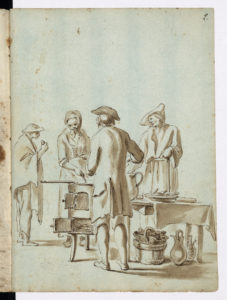
Naples is the city where, by the account of almost all travellers, one eats best. Among them all let us cite Charles de Brosses, so often critical of Italian cooking: “It is here, moreover, that the cooking is done in the best manner: excellent wines […]; superb beef, grapes such as you may imagine, and melons in the dead of winter, it is true that, if they wished, they might be cucumbers”[xix]. Travellers were captivated by the food-trade that went on in the street, in a flood of smells, colours and voices, and Goethe tells us that:
At nearly every corner of the larger streets stand the fryers, their pans full of boiling oil, ready to prepare on the spot, especially on days of abstinence, fried fish and fritters according to the passers-by’s requests. They sell without let-up, and there are thousands who go off carrying what they need for their dinner or their supper wrapped in a scrap of paper. (p. 378)
And for the feast of Saint Joseph:
Today was also the feast of Saint Joseph, patron of all the frittaroli, that is, of the sellers of fried pasta, of the poorest quality, be it understood. And since beneath the black boiling oil a great flame burns without cease, the torment of fire too belongs to their sphere; […] On the thresholds of the houses great pans were set upon improvised hearths. One lad worked the dough, another shaped it and made it into rings that he threw into the smoking oil. A third, beside the pan, drew out the rings with a little spit as they cooked and, with another spit, passed them to a fourth, who offered them to the bystanders. […] Some others completed the group, pouring wine for the workers and drinking of it themselves […] The people thronged round, for on this evening all the fried things are sold cheap, and part of the takings even goes to the poor. (pp. 237–238)
Goethe observes too that at Naples a great quantity of vegetables is eaten: “The whole countryside around Naples is one single vegetable garden, and it is a joy to see the incredible quantities of greens that pour in on market days […] The prodigious consumption of vegetables means that a large part of the city’s refuse consists of the stalks and leaves of cauliflower, broccoli, artichokes, savoy cabbage, lettuce and garlic; and these are refuse extraordinarily sought after” (p. 371). Before the Neapolitans converted to the eating of pasta, they were great eaters of vegetables, whence the epithet mangiafoglie (“leaf-eaters”) by which they were known beyond their own territory[xx]. The Neapolitan poet Giulio Cesare Cortese, who lived astride the sixteenth and seventeenth centuries, in his work Viaggio di Parnaso, addressing the broccoli, makes this exclamation: “O foglia dolce! O foglia saporita! De nuje autre rechiammo e calamita!” (“O sweet leaf! O savoury leaf! To us you are lodestone and magnet!”)[xxi]. At Palermo too, Goethe observes: “the vegetables are exquisite, the salad greens especially, which have the sweetness and flavour of milk: one understands why the ancients called it lactuca” (p. 280). Goethe is right, for lettuce was already much prized by the ancient Romans and was held to be a food so important that when they laid out a military camp they took care to put the plant under cultivation[xxii]. In the following centuries salad was considered the Italian food par excellence: there was no other people that made such use of it as the Italians. In Sicily, again, the driver of their carriage fed on raw artichokes and turnip tops, and Goethe remarks that they are sweeter and more succulent than those eaten in Germany; another speciality is the cardoon, which overran wide tracts of land, and the writer wonders whether it might not be well to grub them up for other crops, until he sees two Sicilian gentlemen “stop before a clump of cardoons and cut off, with sharp little knives, the tips of the tall stalks; then, gripping those prickly conquests of theirs between their fingertips, they stripped away the husk and devoured the pith with relish” (p. 318), and, tasting them himself at the driver’s invitation, he does not find them to his liking.
In the Alto Adige he meets undernourished women and children and observes that the cause may be the use of maize and buckwheat, from which they make two kinds of polenta, one yellow with maize and the second black, known as polenta taragna. Unlike the Tyroleans of the Austrian side, these people eat it just as it is, sometimes with a little cheese and never with meat. On the connection between the illness and the eating of maize Goethe’s observation is sound, even though the link would be discovered only at the end of the nineteenth century. It is, in fact, pellagra, very widespread in these parts. A disease that manifested itself first through lesions of the skin and disorders of the intestinal tract, then, at a more advanced stage, through dementia. The cause was not so much the maize flour as such, but the fact that, once cooked to make polenta, it lost its vitamin PP entirely. In a diet such as that of the poor peasants, devoid of foods rich in vitamins and based predominantly on polenta, the disease took easy hold.
At Naples, again, Goethe gives us a splendid description of the market, that place of the abundance of food, a veritable land of Cockaigne, in which plenty is reconciled with the care of its display:
There is no season in which one does not find oneself surrounded on every side by foodstuffs. The Neapolitan not only loves to eat, but also demands that the wares on sale be handsomely presented. At Santa Lucia the various kinds of fish, prawns, oysters, razor-clams, small crustaceans, are usually presented each in a clean, pretty basket upon a bed of green leaves. The stalls of dried fruit and pulses are decked out with fanciful variety: expanses of oranges and lemons of every kind, with green foliage projecting pleasingly among them. But most carefully tended of all are the displays of meat, upon which the crowd’s greedier glances fasten, since the frequent need to go without whets the appetite. On the butchers’ stalls the quarters of beef, of veal, of mutton are never set out without abundant gildings, whether on the fatty parts or on the flank and the haunch. Several days of the year, above all those of the Christmas season, are given over to gastronomy: the land of plenty is then universal, as though five hundred thousand people had agreed to celebrate it in concert, and the Via Toledo, like many another street and square, is a parade of appetizing displays. The shops that most gladden the eye are those of the greengrocers, who set out raisins, melons and figs. The foodstuffs are hung in garlands arching over the streets; great rosaries of golden sausages tied with red ribbons; turkeys each with a little red pennant beneath the rump. Thirty thousand of them, I was assured, were sold, not counting those fattened by private persons at home. Besides, droves of donkeys laden with vegetables, capons, sucking lambs; there one sees mountains of eggs so gigantic that one cannot believe so many could be heaped together. And it is not enough that all this mass of stuff be consumed: every year a mounted policeman, accompanied by a trumpeter, rides through the city announcing in every square and at every crossroads how many thousands of oxen, calves, lambs and the rest have been devoured by the Neapolitans. The people listen attentively, exult to hear the colossal figures, and each recalls with satisfaction the part he had in the great blow-out. (pp. 377–378)
 For Goethe and his travelling companion Christoph Kneipp, at the inn in Catania where they lodge, a hen is prepared together with rice which “in truth would not have been to be despised, had an inordinate dose of saffron not turned it yellow and, moreover, rendered it inedible” (p. 321). It seems that the pairing of hen and rice was customary in Sicily, for at Caltanissetta the two buy a hen and the driver goes off in search of rice, salt and seasoning to cook it. But the thing that most strikes one is the aversion to saffron, an ingredient much used in the island’s cooking both for its flavour and for its power to colour food. Labat too, at Sanremo, does not care for pasta dressed with hen because it has a bad smell, due surely to the use of saffron. The German man of letters and the French Dominican bear witness to a revolution in taste, begun in France in the seventeenth century, which banishes spices, central to medieval and Renaissance cooking, in favour of the rediscovery of “natural”, unadulterated flavours. Sauces too would change: from those with an acid base, using vinegar, lemon or verjuice, to those with a fatty base, using butter and oil. We find that the French travellers, when they go to countries where great use is still made of spices, saffron in particular, criticise its employment[xxiii]. The agronomist Nicolas de Bonnefons, who in the mid-seventeenth century was the theorist of the nouvelle cuisine of the day, writes: “in the villages they put saffron [in the rice] to give it the colour and the taste to which they have been accustomed since antiquity, though it be bad”[xxiv]. If Bonnefons was “merely” an agronomist, the most influential cook in France, François Pierre de la Varenne, in his Cuisinier françois of 1651 drastically reduces the use of spices, and across more than six hundred recipes saffron appears in only four.
As for wine, the poet of Weimar tells us little, though from the letters and diaries of friends it appears that he enjoyed it, alternating periods of heavy drinking with near-abstinence[xxv]. Perhaps the Italian period was one of the latter, for in a letter written to Charlotte von Stein from Vicenza he writes: “I live very soberly; the local red wine, and this ever since I left the Tyrol, I cannot abide: I water it well down, as Saint Louis used to do”[xxvi]. At Alcamo, in Sicily, he is astonished that the driver should dilute the wine with water and, on his asking the reason, “he answered us without batting an eye that he had left it a third empty and that, since no one drinks wine neat, it was as well to water it down entirely at once; that way the liquids mixed better, and besides there was no certainty of finding water everywhere.” (p. 296) This takes us back to the way wine was drunk in antiquity, when it was always mixed with water. A habit still very common with the wines we would today call “peasant” wines, to temper their harshness and acidity, or because, as often happened through poor keeping, they had oxidised.
It is the French, notoriously great producers of wine, who most often speak of the beverage, comparing it with the wines made in France. Take Misson, who sums up thus: “In Italy there are wines of every sort, but the good ones are the rarest; in the environs of Rome one finds the wine of Genzano, of Albano and of Castel Gandolfo, all from one and the same soil. The Greco of Naples and the Lachryma Christi are vigorous wines; we made do with the little white asprino, or the piquant chiarello, though these are far less esteemed. At Florence and at Montefiascone the best wines are agreeable and have no more fire than the ordinary drink requires, but there is only a little of them. The Grand Duke’s delicate Moscadello is a small vintage reserved for his own mouth, or for gifts: one must not suppose it is to be had everywhere. There are good wines too near Verona and in the State of Genoa”[xxvii]. Brosses often speaks of wines: he mocks the ladies of Turin who pull faces on drinking Champagne, because they are not used to it and prize, in his view, some very poor wines. In the South he writes that: “the wines of Formia, though inferior to the foregoing [Falerno and Massico], are still the best in Italy, and those of greatest strength are those of Vesuvius. They are very full-bodied, like our heavy wines of Nuits or of Pontac, of high degree, with a little perfume, and are moreover somewhat sweet, which is one thing too many. They must be aged for some years, and I am sure they would be excellent if they were kept long, made in the manner of the ancient Romans”[xxviii].
For the travellers who, between the mid-seventeenth and the end of the eighteenth century (the period corresponding to the Grand Tour), came to Italy, the relation with food in the taverns and hostelries they encountered above all while on the move is substantially negative. One ate badly, and moreover these places were very dirty; Goethe, however, seems not to notice, or does not tell us of it. When, by contrast, the grand tourists were entertained in the residences of the aristocracy and the high clergy, the quality of the food continued, as by age-old tradition, first and foremost to represent the standing of the host. In both quantity and quality it mirrored what the Renaissance banquets had been, the period when Italian cooking was held throughout the continent to be the best and a model to look to. One may speak of a common sensibility that then marked the European aristocracy. But now the picture had changed, for most of the principal countries had their own “national cuisines”, typical ways of cooking or dishes that struck the visitor, as pasta did in Italy. From the middle of the seventeenth century France established itself as the winning culinary model, one that penetrated other countries as well. In this period recipe books came out in Italy that took up the French ones, such as the one printed at Bologna in 1682 with the telling title Il cuoco francese (The French Cook). If eating is an aspect of culture and taste, it is no wonder that the France of the Enlightenment should have exerted a strong attraction upon the high society of the rest of Europe in the matter of food as well.
From the texts of the travellers examined it emerges, in some cases, how keenly the nostalgia for home food was felt, food naturally held superior to that found on the road[xxix], and this is no wonder, for in traditional societies the conviction was very widespread that only the foods of one’s own culture were the best. Indeed, even today, in the age of mass tourism, one sometimes registers a scant curiosity for the food of the other, and tourists go in search of those restaurants that offer the cooking of their own country.
Taste is a product of history and of culture, and it stands at the crossroads between what is subjective and what, instead, belongs to culture, understood also as social belonging. Food taste, however, is not static; it may change through many factors. We have touched on the gastronomic revolution of mid-seventeenth-century France, which brought about a change of taste beyond that nation too. Moreover, the French ate little salt compared with other European peoples, and this was a cause of displeasure when they travelled; the English loved beef, which others found common; the English did not care for sauces and gravies, whereas the French and the Italians used them a great deal, and so on[xxx]. Then there is the taste for what is rare, sought-after and costly, and its prizing is born precisely of this. The history of spices is the most emblematic example: as long as they were a rarity, and hence very dear, great use was made of them among the elites; when importation increased and the price fell, interest waned, and it was other products that marked distinction. The seventeenth and eighteenth centuries register, too, a greater attention than in other periods on the part of the aristocracy to dirt and to cleanliness at table, of which the travel accounts, as we have seen, give ample testimony.
Finally, contact between different cultures, from the point of view of food too, during travel can give rise to phenomena of acculturation: an example is the young Englishmen who become such devotees of pastasciutta as to make a fashion of it. The painter Jones, on the ship carrying him from Naples to London, has among the provisions taken aboard also “24 pounds of maccheroni”[xxxi]. Or the reverse. Such is the case, how widespread I do not know, of what the English writer Lady Mary Wortley Montagu recounts; she lived for a long period in Italy, and in a letter addressed to her daughter from Lovere on Lake Iseo in 1751 she boasted of having taught the inhabitants: “to make bread, in which they were vegetating in the same ignorance lamented by Misson (as you may see in his letter from Padua). I have introduced French rolls, custard, little tarts and plum pudding, of which they are very fond. It is impossible to bring them round to syllabub [a drink of freshly milked milk curdled with wine], a mixture so unnatural in their eyes that the mere sight of me eating it scandalises them. But I look for immortality from the science of butter-making, in which they have become so accomplished thanks to my instructions; I can assure you that here it is as good as in any part of Great Britain”[xxxii].
Notes
[i]C. de Brosses, Viaggio in Italia. Lettere familiari, pref. by C. Levi, Laterza, Rome-Bari 1992, pp. 568–570 [orig. title: Lettres familières sur l’Italie].
[ii]F.M. Misson, Viaggio in Italia, trans. and ed. by G.E. Viola, L’Epos, Palermo 2007, p. 338 [orig. title: Nouveau voyage d’Italie avec un Mémoire contenant des avis utiles à ceux qui voudront faire le mesme voyage].
[iii]A. Miller, Letters from Italy describing the manners, customs, antiquities, paintings, etc. of that country, in the years MDCCLXX and MDCCLXXI, to friend residing in France, 2nd ed. revised and corrected, 2 vols. Edward and Charles Dilly, London 1776, II, pp. 288–289.
[iv]Brosses, Viaggio in Italia cit. p. 275.
[v]F. Correnti and G. Insolera, I viaggi del padre Labat dalle Antille a Civitavecchia. 1693-1716, Officina, Rome 1995, p. 173.
[vi]C. Burney, Viaggio musicale in Italia, ed. by E. Fubini, EDT, Turin 1979, p. 219 [orig. title: The present state of music in France and Italy].
[vii]C.U. von Salis-Marschlins, Viaggio nel Regno di Napoli, ed. by G. Donno, Lorenzo Capone editore, Cavallino di Lecce 1979, p. 97 [orig. title: Reisen in verschiedenen Provinzen des Königreichs Neapel].
[viii]T. Jones, Viaggio d’artista nell’Italia del Settecento. Il diario di Thomas Jones, ed. by A. Ottani Cavina, Electa, Milan 2003, p. 171.
[ix]T. Smollett, Viaggio attraverso l’Italia. Disavventure, pregiudizi e fugaci consolazioni di un romanziere scozzese nel Bel Paese, trans. by P. Saitto-Bernucci and C. Spadaccini, Nutrimenti, Rome 2003, p. 110 [orig. title: Travels through France and Italy].
[x]Ibid. p. 114.
[xi]Ibid. p. 63.
[xii]J.W. Goethe, Italian Journey, trans. by E. Castellani, commentary by H. von Einem adapted by E. Castellani, pref. by R. Fertoni, Mondadori, Milan 1983 [orig. title: Italienische Reise]. From here on, the page numbers of the quotations are given in the text.
[xiii]We have the testimony of an Irish traveller who was much struck by it. Cited in J. Dickie, Con gusto. Storia degli italiani a tavola, Laterza, Rome-Bari 2007, p. 199.
[xiv]M. Serao, Il ventre di Napoli, repr. of the 1884 ed. L’Unità, Rome 1993, p. 21.
[xv]See L. Cesari, Storia della pasta in dieci piatti. Dai tortellini alla carbonara, Il Saggiatore, Milan 2021, pp. 143–144.
[xvi]Correnti and Insolera, I viaggi del padre Labat cit. p. 212.
[xvii]For this and other information on pasta, see the fundamental volume by S. Serventi and F. Sabban, La pasta. Storia e cultura di un cibo universale, Laterza, Rome-Bari 2000.
[xviii]J. de Lalande, Voyage d’un François en Italie fait dans les années 1765 et 1766, 8 vols. Desaint, Paris 1769, VI, p. 393.
[xix]Brosses, Viaggio in Italia cit. p. 289.
[xx]See the now-classic essay by E. Sereni, Note di storia dell’alimentazione nel Mezzogiorno: i napoletani da “mangiafoglia” a “mangiamaccheroni” first published in “Cronache Meridionali”, no. 4-6 (1958) and reprinted in the volume Terra nuova e buoi rossi, Einaudi, Turin 1981.
[xxi]Cited in Y. Carbonaro, Il cibo racconta Napoli. L’alimentazione dei napoletani attraverso i secoli fino ad oggi, Kairós, Naples 2017, p. 120.
[xxii]A. Marzo Magno, Il genio del gusto. Come il mangiare italiano ha conquistato il mondo, Garzanti, Milan 2014, p. 117.
[xxiii]See P. Gillet, Par mets et par vins. Voyages et gastronomie en Europe XVII-XVII siècles, Payot, Paris 1985, pp. 159–167.
[xxiv]Cited in F. Antinucci, Spezie. Una storia di scoperte, avidità e lusso, Laterza, Rome-Bari 2014, p. 113.
[xxv]E. Grasdorf and P. Brunner, A tavola con Goethe. Ricette del tempo dei classici tedeschi, Guido Tommasi, Milan 2001, in particular: Dalla bottiglia al bicchiere: cosa beveva Goethe, pp. 19–31.
[xxvi]Ibid. pp. 22–23.
[xxvii]Misson, Viaggio in Italia cit. p. 338.
[xxviii]Brosses, Viaggio in Italia cit. pp. 274–275.
[xxix]This is the case of Sir Peter Beckford, who complains of finding no boiled pig’s trotters, no pea puddings and above all no bubble-and-squeak, a dish regarded as a speciality in the United Kingdom, consisting of salt beef boiled and then sliced and fried, served with boiled and fried cabbage and other vegetables. Cf. R. Tannahill, Storia del cibo, Rizzoli, Milan 1987, pp. 274 and 305.
[xxx]See J.-L. Flandrin, La cucina europea moderna: un crocevia di esperienze culturali (XVI-XVIII secolo) in M. Montanari (ed.), Il mondo in cucina. Storia, identità, scambi, Laterza, Rome-Bari 2002.
[xxxi]T. Jones, Viaggio d’artista nell’Italia del Settecento cit. p. 204.
[xxxii]M. Wortley Montagu, Cara bambina. Lettere dall’Italia alla figlia (1747-1761), ed. by M. d’Amico, Adelphi, Milan 2014, pp. 92–93.
Alberto Sorbini was director of the Institute for the History of Contemporary Umbria; he works on the history and anthropology of food, on travel in Italy, and on emigration. On these themes he has written books and articles.
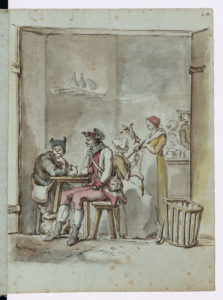
The images are drawn from the drawings of the Perugian painter Carlo Spiridione Mariotti (1726–1790). They are scenes of Perugian life gathered in 70 sketchbooks, which the Regional Assembly of the Region of Umbria acquired in 1974 and which it has kindly authorised for reproduction in this text.