Olive Trees in Umbria
A 9-minute read
In Umbria, the belt between 250 and 500 m in altitude has the olive tree as its characteristic element; in some cases we can observe scattered olive groves even higher up, as in the Valnerina. The emblem of this arrangement is the Assisi – Spoleto olive belt, a true jewel of historic olive growing, recognised by the FAO as an agricultural heritage of worldwide importance. It is crossed by the Olive Trail, laid out more than a decade ago by members of the Spoleto branch of the Club Alpino Italiano. Every year thousands of tourists and walking enthusiasts follow the trail and can make use of services such as farm stays, farm eateries and restaurants. Artistic and historical landmarks are not lacking, both along the trail and in the towns and cities that form part of it. The olive landscape does not, of course, stop at the Assisi Spoleto line: every Umbrian hill is a landscape in its own right, with the olive grove as its protagonist, more or less interspersed here and there with woods, thickets, rocks and badlands.
This complexity of landscapes, due to the orography of our region, has allowed the selection of the numerous cultivars present; it is worth noting that, in proportion to its surface area, Umbria has well over 100 local cultivars, many of them forgotten and perhaps surviving in just one or a few specimens in marginal areas. The olive trees, resilient witnesses to a heroic olive growing made up of trees scattered across the natural hollows of the hillsides, are often reinforced by dry-stone walls, lunettes or other forms of support for the meagre soil available.

Scattered here and there are many centuries-old olive trees, and some millennial ones such as the olive of Sant’Emiliano at Bovara di Trevi, together with another specimen of the same variety at Cesi, in the province of Terni, the Raia of Macciano and the one at Giano dell’Umbria, to name the oldest currently known; but the Umbria region, from north to south, is full of specimens between 400 and 800 years old.
The monumental olive trees of the Dolce Agogia variety are very widespread in the Trasimeno area and in the municipality of Perugia, home to the oldest specimen, about 700 years old. A few years ago, during the Easter holidays, we learned that the centuries-old grove to which the oldest Dolce Agogia mentioned above belongs, the olive of Piscille, was being uprooted; alarmed, we tried to prevent it by turning to the regional offices, but we obtained no great results and the centuries-old grove went on being decimated. After a few days I personally brought in the Carabinieri Forestali, the forestry police, who this time did intervene and saved the tree and what remained of the grove. We shall never be able to thank them enough.
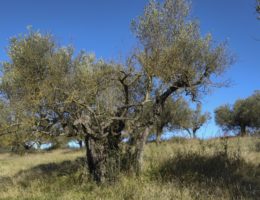
Today this majestic tree needs care suited to ancient plants: fertilisation and pruning first and foremost. We hope this article may serve to bring recognition to this specimen, as to so many others that deserve to be safeguarded, known and valued.
It must be said that for some years now olive groves have been appearing on flat land below 200 m in altitude; this is due to the perception of climate change. Often these groves are managed in a super-intensive form, a cultivation system that does not respect the plant and, above all, is not sustainable, given the high consumption of water and energy inputs. One aspect of industrial agriculture that often goes unnoticed is the lack of respect for the plant, for water, for the air and for the land. Let us imagine this system adopted on a large scale: we would witness a destruction of the Umbrian landscape together with a very severe genetic erosion of the dozens of neglected varieties that pervade the historic olive groves, repeating what has happened in Spain over the last 30 years.

The research group of the CNR IBBR in Perugia, led by Dr Luciana Baldoni, is at the forefront of the knowledge and protection of local varieties and monumental specimens, not only at regional but at international level.
As for the oils extracted from the fruits of these neglected varieties, also thanks to new extraction technologies, very high chemical and organoleptic potential is being found, potential that in the past, when stone mills were used, probably did not fully express its character because of the strong oxidation to which the olive paste was subjected throughout the extraction process; or else the producer and the consumer were not yet properly educated about oil quality, and the aim was exclusively quantity.
Alongside Leccino and Frantoio, by now cultivars widespread worldwide, including areas very far from their original one; alongside Moraiolo, characteristic of central Italy, which adapts poorly to hot climates; and Dolce Agogia, typical of and widely grown in the Perugia area and around Lake Trasimeno, we find a whole series of lesser-known but certainly very interesting cultivars, some of which are gaining ground. As an example, we may cite local varieties grown on a small scale that have established themselves as veritable stars of taste, benefiting too from the technological advances in oil extraction: among them the Borgiona variety of the upper Tiber valley, the Raio of Amelia, the Gentile Grande, also called di Anghiari, in the Upper Tiber Valley, and more recently the Limona in the Gubbio-Gualdo area, the Pocciolo in the Spoleto area, the San Felice on the Martani mountains; and many others await recognition, while the latest studies under way will soon hold surprises for us.
Unfortunately, few or no nurseries offer plants of local olive varieties, whether out of ignorance, on the part of both the grower and the olive farmer, of the organoleptic characteristics of the oil, of the agronomic behaviour, and of the organoleptic traits of the oil and the olives. If we think, for instance, of the world of table olives, in Umbria there is no tradition of preparing table olives, with the exception of the so-called olive gelate (“frozen” olives), for which the Dolce Agogia cv is used in the Perugia area and the Raia cv in the Spoleto area. In our research on local varieties we have come across some that would be suitable for natural curing and brining, both as green and as black olives, some of them already entered in the regional and national register of Umbrian olive varieties.
The most widespread varieties from north to south of the region:

During the research carried out by our CNR-IBBR group in Perugia, numerous native trees were surveyed and saved, many of which then turned out, under molecular analysis, to be unique genotypes. The map that follows shows their location.
Why concern ourselves with abandoned cultivars? The reasons are many. The first impulse was to save a unique germplasm, one therefore at risk of extinction in an olive growing that is heading towards standardisation and monoculture; then it was realised that these varieties could have an agronomic value, because they carry unique genetic traits that are potentially useful in the fight against biotic and abiotic stresses; but they certainly also have a strong economic potential, since one variety for each area means telling the first from the second and vice versa. This possibility opens new horizons in the oil trade: where standardisation once seemed to be the rule, today a singularity is sought. In raising producers’ awareness, associations such as Slow Food also play an important role, their philosophy being to save diversity, understood also as the territoriality of taste.

Let us also take a look at the more hedonistic aspect, namely the aroma and flavour of an oil extracted from the Umbrian varieties. Among the best-known and most cultivated is Moraiolo, marked by rather pronounced artichoke notes, sometimes a light tomato, a green fruitiness of freshly cut herbs, with a bitterness and pungency of considerable impact and persistence; then Frantoio, which strikes you at once with its floral aroma, its very persistent olive fruitiness and its notes of almond; and Leccino, a cultivar whose character varies with the course of the season, for example this year (2020) it did well, perhaps one of the best vintages ever, with an intense scent of freshly cut grass.
Turning to less common varieties, in the upper Tiber valley the Borgiona (synonyms Borsciona and Morcona) is marked by strong notes of tomato, an agreeable bitterness and a fine peppery pungency. In the Amelia area the Raio, represented by great monumental trees, produces olives that, once pressed, reveal unique characteristics such as a long, persistent walnut bitterness, combined with a peppery pungency and fruity notes of green olive; a rare oil, owing to the smallness of the territory and to the abandonment of many centuries-old specimens. We could go on, but we shall perhaps save for another article the pleasure of illustrating some of the Umbrian varieties and their precious oils.
After the invention of the screw press, oil-making technology remained practically unchanged for millennia. Well, today extraction technology allows us to appreciate cultivars that until two decades ago were mere producers of fat and today yield savoury oils, rich in aromas, in a word fantastic. Among these we have spoken of the Borgiona and the Raio; we are now discovering the Limona, made in purity by practically only two producers, as is also the case for the Nostrale di Rigali, which, if harvested early, is a most pleasant discovery. We are certain we shall have great surprises in the coming years; our certainty comes from the recent chemical analyses and from a sensory analysis which, thanks to experience, allows us to associate the aroma of the olive and its flavour with the future sensory expressions of the oil, though clearly this last is not a customary or codified technique… yet.
In short, the study of local varieties is certainly a means of saving the local germplasm, and with it the landscape and both agronomic and environmental sustainability, from the onslaught of super-intensive plantings made with a handful of cultivars of an origin other than the local one, plantings that are distorting the typical taste of the oils produced from local cultivars and impoverishing the culture bound to individual territories.
Saverio Pandolfi, CTER level IV at the CNR IBBR in Perugia, PhD in the productivity of cultivated plants, formerly director of the experimental farm of the Istituto Sperimentale per l’Olivicoltura, now CREA; teacher on numerous training courses in fruit-tree pruning, herbaceous and tree crops, the processing of agricultural products, business economics, the innovation of agricultural products and farm multifunctionality. Regional coordinator for the Slow Food guide to extra-virgin olive oils, international olive-oil taster.
Roberto Mariotti, CTER level VI technician at the CNR-IBBR in Perugia.
An expert in molecular analyses, which he applies to the study of phylogeny, the identification of QTLs, and the traceability of olive trees and oil. Expert olive-oil taster at international level.