KERAMOS. The Arts of Giorgio Crisafi
A 5-minute read
“Though he works with clay and fire, elements typical of the world of ceramics, Giorgio Crisafi employs unusual materials and techniques, bringing his own original contribution to this ancient art”
Nino Caruso
GIORGIO CRISAFI was born in Todi in 1952 and later trained at the University of Bologna, where he studied History of the Theatre and History of Art under Flavio Caroli and Renato Barilli (1971–75) while embarking on his own career in the theatre. As an actor and director, he took part in leading festivals for the promotion of new Italian and international dramaturgy. Between 1983 and 1986, in Todi, he was founder and artistic director, together with Enzo Siciliano and Alessio Vlad, of the Settimana Tudertina, a theatre and music festival later known as the Todi Festival.
From the 1980s onwards he played leading and title roles with the foremost Italian theatre companies, actors and directors: Alberto Lionello, Adriana Asti, Tieri-Lojodice, Gabriele Lavia. In 1980 he founded and directed the Prima Compagnia Teatro in Todi & Co. He also began a decade-long collaboration with the writer Enzo Siciliano, becoming the interpreter of much of his dramatic work.
From his very beginnings he combined the theatre with collaborations alongside renowned artists and started his own work in his studio-workshop in Todi. He was assistant to the painter Piero Dorazio from 1975 to 1985, also curating the catalogues of Dorazio, Beverly Pepper and Titina Maselli on the occasion of their retrospective exhibitions.
He worked in the studio and in the theatre with the ceramist sculptor Nino Caruso (2003–04) and with the painter and set designer Bruno Ceccobelli (1998 and 2004). As a ceramist sculptor he has taken part in six solo shows and twenty-five group exhibitions, showing his work in archaeological sites, galleries and museums, in particular La scultura ceramica contemporanea in Italia at the Galleria Nazionale d’Arte Moderna in Rome (2015) and Mediterraneo-Keramikos at the Museo Nazionale della Ceramica Duca di Martina in Naples (2020). In 2020 he was awarded the San Valentino Arte prize for sculpture.
He is the author of five theatrical texts and adaptations. In 2014 he published a book of poems dedicated to his life as a stage actor: “In tournée” (AG Book Publishing, Rome).
Recently I have opened an exhibition gallery in the centre of Todi, the “Spazio Giorgio Crisafi”.

Sculpture as an enigmatic ceremonial presence
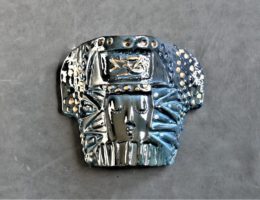
Distant, almost sidereal, yet at the same time near. Among their other qualities, the works – sculptures and bas-reliefs – of Giorgio Crisafi have that of uniting opposites: they possess and convey a kind of precious aristocratic reserve, something bashfully aloof that at first sight keeps us at a respectful distance, but that then gives way to the urge to caress those forms, so mysterious and polished as to become, all too easily, objects of desire. While the bas-reliefs are avowedly heraldic and bear witness to a nobility of soul sustained by ancient chivalric ideals, as well as to the purity of conduct to which the artist aspires, the sculptures are ceremonial, ritual presences that take on the guise of totems or apotropaic idols, charged with an archaic quality that is nonetheless shot through with the anxieties of our own age. After all, an archaic component is an essential part of ceramics itself, if one only considers that the firing of earth is among the first signs of human civilisation. Not to forget that all four of the mythical elements that make up the world – water, air, earth and fire – come into play as protagonists in the making of a work in ceramic.

In some way, Crisafi’s sculptures and bas-reliefs are the making-concrete of his own states of mind, arising at the moment of stepping onto the stage of the theatrum mundi, of giving outward form to himself, declaring his faith in the respect for human values, almost like an ancient knight hurled into the third millennium by who knows what strange destiny. And through this kind of inner mirroring the words of a great master of twentieth-century ceramics, Leoncillo, come to mind: “To cut clay with the wire is to carry out a decisive act, cruel and liberating. Clay is like my own flesh; it is a process of absolute identification. […] Clay, my clay, my material, artificial, yet charged by metaphor with everything I have seen, loved, been close to; clay charged by metaphor with the things I carry within me, with which, in the end, time and again, I have identified myself. An organic quality born of the matter I handle with my own hands, soft, hard, harsh, sensitive, of the gestures I make with it and upon it, along the thread of a present memory, of a distant identification, buried and yet near”.


Also very strong in Crisafi’s works is a metamorphic capacity that fuses and confuses the residues of human, animal and vegetal presences into an endless continuum, estranging, disorienting and surprising. And yet each of his works seems to guard jealously a secret in its belly, something precious and intangible, a spiritual gem welling up as from a spring, which now and then rises to the surface, as is clearly evident, for instance, in “Araldico selenio” (2006), “Intimogiallo” (2006), the ironic “Papaya” (2006), the “Madonna del becco” (2006), “Araldodidio” (2006), “Collorotrè” (2007), “Un cavallo per cappello”, “A malìa” (2007), “Soltanto incanto” (2007), “Realmente” (2007), to name but a few.


Crisafi’s sculptures always possess the visionary quality of going beyond mere objectual or representational presence; they allude to an elsewhere in perpetual becoming, suspended between natura naturans and the unfathomable depths of an inner world brimming with sensibility. This formal multiplicity of theirs seems, too, to spring ideally from the advice that the great Arturo Martini used to give his pupils: “ Never think that this is a nude, or it will trouble you and cut off all your poetic possibilities. Imagine instead that this form imprisoning you is a journey of your own, where you come upon waterfalls, plains, sky, water […]”, a sculpture that “is not rock, but water and sky, that turns clay into stormy seas, that is not a style but a substance”. A substance which, for Crisafi, is aimed at producing enchantment and wonder.
Gabriele Simongini is an Italian art historian and critic. He teaches at the Accademia di Belle Arti in Rome. He is the art critic of the daily newspaper Il Tempo and an essayist. His research deals in particular with Italian abstract art.